


EYFS
Intent
“Children learn and develop more from birth to five years olds than at any other time in their lives.”
(Development Matters Revised 2021)
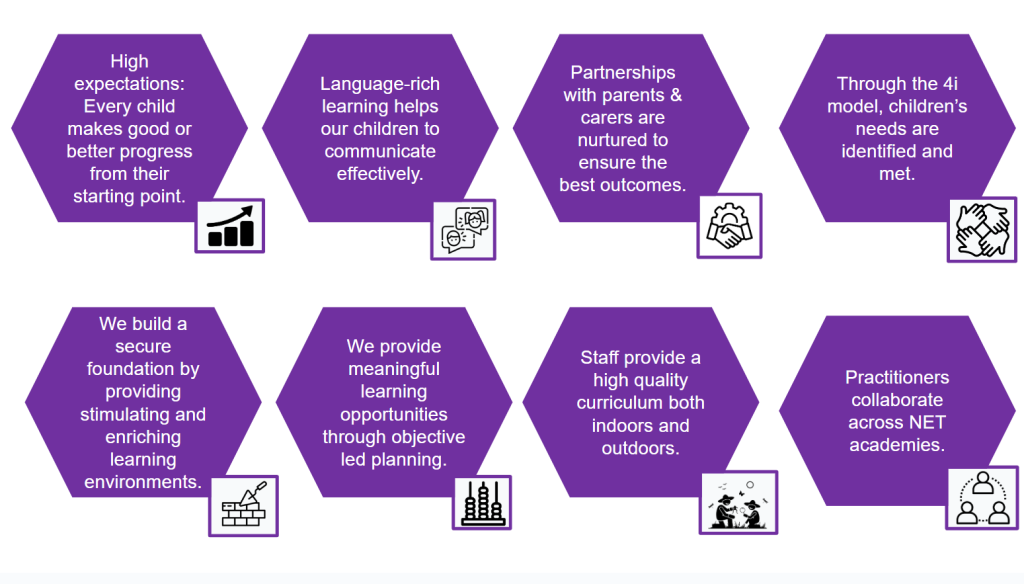
Here are the NET EYFS aims.

Implementation
We place our children at the centre of everything we do, fostering a child-centric and outcome-driven approach. We provide a stimulating, safe and warm environment where learning is fun and accessible for all children. Our Early Years environment fosters curiosity, engagement, and exploration. By thoughtfully selecting age-appropriate materials, arranging learning zones, and incorporating sensory experiences, we ensure that every aspect of our Early Years environment ignites a passion for learning.
Our curriculum is inspiring and relevant; children engage in activities that promote and extend their curiosity and awareness of their world.
We ensure that the learning and development opportunities and experiences provided are clearly linked to both the ‘Prime’ and ‘Specific’ areas of learning.
Prime areas:
- Communication and language
- Physical development
- Personal, social and emotional development
Specific areas:
- Literacy
- Mathematics
- Understanding the world
Experiences and activities planned reflect the different ways that children learn. Our academy supports children in using the three characteristics of effective teaching and Learning.
Characteristics of Effective Teaching and Learning:
- Playing and exploring – children investigate and experience things, and ‘have a go’
- Active learning – children concentrate and persist if they encounter difficulties, and enjoy achievements
- Creating and thinking critically – children have and develop their own ideas, make links between ideas, and develop strategies for doing things.
Impact
The environment and curriculum systematically prepare children for a seamless transition into Key stage 1, not just learners, but as joyful, self-assured, resilient and independent individuals eager to absorb knowledge. The curriculum builds upon the Childs’ prior knowledge and ensures every child achieves good progress from their starting point. Sequential, objective-led planning ensures that there is a balance of child-initiated and adult directed learning experiences. This encourages learning through play and exploration, promoting confidence, self-esteem and independence. Children are provided with a range of rich, meaningful first-hand experiences in which they explore, think creatively and are active.
Teaching Reading, Writing and Vocabulary in EYFS
All children in our EYFS are expected to make good or better progress in English. A high-quality education in English teaches children to speak and read and write fluently so that they can communicate their ideas and emotions to others. This enables children to develop culturally, emotionally, intellectually, socially and spiritually. Children are provided with a vast range of opportunities to develop their knowledge and understanding of spoken and written English within a broad and balanced curriculum. Children are given ample opportunities to consolidate and reinforce the English skills they have been taught, and to apply them in a range of contexts.
Phonics
In our academy, we use the DfE accredited, ‘Essential Letters and Sounds’ Phonics programme to ensure that as many children as possible learn to read well.

EYFS Mathematics
Mathematics is taught using a mastery approach where the embedding of mathematical concepts or skills are mastered through exploration, clarification, practice and application over time. Our EYFS use this teaching approach to help children to master the mathematical concept or skill and be able to independently represent this in multiple ways. This approach also gives children the mathematical language to communicate their thinking and processes then independently apply this in an unfamiliar situation. Through this approach, we expect every single child to succeed.
Parents as Partners in Learning
Parents are an essential part of a child’s education. Children’s experiences in their first 5 years have been shown to have a significant impact on their developmental outcomes later on. Our academy recognises the importance of positive partnerships between practitioners and parents/carers are key to ensuring positive experiences for children within their education. Parents are encouraged to come and speak to staff at any time and feel comfortable in the early years setting.
Parents offered the following:
- Workshops based around curriculum areas
- Workshops based around the wellbeing and safety of their child
- Celebration assemblies
- Showcases such as Nativity shows
- Stay and play sessions
- Regular invitations to the Starbooks Café, or equivalent, the academy library to read with their child and borrow books to support developing a love of reading.
- A lending library for access to story books is provided for parents to borrow each day
- Regular parent consultation meetings to keep parents informed about their child’s progress.
- Parents or carers are able to view their child’s progress, the activities provided for them, and how much fun they’re having in academies, through the Tapestry app.
- Parents are able to showcase their children’s learning at home through the Tapestry app which ensures both parents and practitioners get the very best picture of the individual child as a learner.

Starting Reception
Starting school is an important milestone in every child’s life. We want to work together with parents and caregivers to ensure that all children are equipped with the skills needed to have a successful start to their education and are ready to start school.
We are pleased to share with you The Starting Reception definition which was developed by a unique collaboration of leading early years organisations. It provides parents and caregivers with a wealth of information and tips to support school readiness. It sets out the personal, social, emotional and physical skills that most children will develop by the time they start school.
More information and guidance on how to help your child from birth to school age is available on the Starting Reception website. Their website is currently available in seven other languages. To switch between languages use the dropdown menu in the top right corner of their website.
https://startingreception.co.uk/
EYFS
Intent
“Children learn and develop more from birth to five years olds than at any other time in their lives.”
(Development Matters Revised 2021)
Here are the NET EYFS aims.
Implementation
We place our children at the centre of everything we do, fostering a child-centric and outcome-driven approach. We provide a stimulating, safe and warm environment where learning is fun and accessible for all children. Our Early Years environment fosters curiosity, engagement, and exploration. By thoughtfully selecting age-appropriate materials, arranging learning zones, and incorporating sensory experiences, we ensure that every aspect of our Early Years environment ignites a passion for learning.
Our curriculum is inspiring and relevant; children engage in activities that promote and extend their curiosity and awareness of their world.
We ensure that the learning and development opportunities and experiences provided are clearly linked to both the ‘Prime’ and ‘Specific’ areas of learning.
Prime areas:
- Communication and language
- Physical development
- Personal, social and emotional development
Specific areas:
- Literacy
- Mathematics
- Understanding the world
Experiences and activities planned reflect the different ways that children learn. Our academy supports children in using the three characteristics of effective teaching and Learning.
Characteristics of Effective Teaching and Learning:
- Playing and exploring – children investigate and experience things, and ‘have a go’
- Active learning – children concentrate and persist if they encounter difficulties, and enjoy achievements
- Creating and thinking critically – children have and develop their own ideas, make links between ideas, and develop strategies for doing things.
Impact
The environment and curriculum systematically prepare children for a seamless transition into Key stage 1, not just learners, but as joyful, self-assured, resilient and independent individuals eager to absorb knowledge. The curriculum builds upon the Childs’ prior knowledge and ensures every child achieves good progress from their starting point. Sequential, objective-led planning ensures that there is a balance of child-initiated and adult directed learning experiences. This encourages learning through play and exploration, promoting confidence, self-esteem and independence. Children are provided with a range of rich, meaningful first-hand experiences in which they explore, think creatively and are active.
Teaching Reading, Writing and Vocabulary in EYFS
All children in our EYFS are expected to make good or better progress in English. A high-quality education in English teaches children to speak and read and write fluently so that they can communicate their ideas and emotions to others. This enables children to develop culturally, emotionally, intellectually, socially and spiritually. Children are provided with a vast range of opportunities to develop their knowledge and understanding of spoken and written English within a broad and balanced curriculum. Children are given ample opportunities to consolidate and reinforce the English skills they have been taught, and to apply them in a range of contexts.
Phonics
In our academy, we use the DfE accredited, ‘Essential Letters and Sounds’ Phonics programme to ensure that as many children as possible learn to read well.
EYFS Mathematics
Mathematics is taught using a mastery approach where the embedding of mathematical concepts or skills are mastered through exploration, clarification, practice and application over time. Our EYFS use this teaching approach to help children to master the mathematical concept or skill and be able to independently represent this in multiple ways. This approach also gives children the mathematical language to communicate their thinking and processes then independently apply this in an unfamiliar situation. Through this approach, we expect every single child to succeed.
Parents as Partners in Learning
Parents are an essential part of a child’s education. Children’s experiences in their first 5 years have been shown to have a significant impact on their developmental outcomes later on. Our academy recognises the importance of positive partnerships between practitioners and parents/carers are key to ensuring positive experiences for children within their education. Parents are encouraged to come and speak to staff at any time and feel comfortable in the early years setting.
Parents offered the following:
- Workshops based around curriculum areas
- Workshops based around the wellbeing and safety of their child
- Celebration assemblies
- Showcases such as Nativity shows
- Stay and play sessions
- Regular invitations to the Starbooks Café, or equivalent, the academy library to read with their child and borrow books to support developing a love of reading.
- A lending library for access to story books is provided for parents to borrow each day
- Regular parent consultation meetings to keep parents informed about their child’s progress.
- Parents or carers are able to view their child’s progress, the activities provided for them, and how much fun they’re having in academies, through the Tapestry app.
- Parents are able to showcase their children’s learning at home through the Tapestry app which ensures both parents and practitioners get the very best picture of the individual child as a learner.
Starting Reception
Starting school is an important milestone in every child’s life. We want to work together with parents and caregivers to ensure that all children are equipped with the skills needed to have a successful start to their education and are ready to start school.
We are pleased to share with you The Starting Reception definition which was developed by a unique collaboration of leading early years organisations. It provides parents and caregivers with a wealth of information and tips to support school readiness. It sets out the personal, social, emotional and physical skills that most children will develop by the time they start school.
More information and guidance on how to help your child from birth to school age is available on the Starting Reception website. Their website is currently available in seven other languages. To switch between languages use the dropdown menu in the top right corner of their website.
https://startingreception.co.uk/
Best Start in Life
The “Best Start in Life” website is a government resource which provides parents and caregivers with a hub of information to support children from pregnancy to starting reception. The site covers a wide range of topics and services, all aimed at giving children the best possible start in life. Key areas of focus include:
- Health & Development: It provides essential health advice from the NHS on topics like pregnancy, baby care, feeding (breastfeeding and weaning), and child development.
- Childcare & Education: Information on government-funded childcare schemes, including the 15 and 30 hours of free childcare, and includes an eligibility checker to help parents see what support they qualify for.
- Family Services: It links to and provides details on the new “Best Start Family Hubs,” which offer a network of local support services, including parent groups, counselling, and financial advice.
- Early Learning: The website provides resources and tips to help prepare children for school, focusing on key skills like language, communication, and social development.
https://www.beststartinlife.gov.uk
